The time of “borrowed” audiences is ending.
If you are still relying solely on Instagram or TikTok to reach your followers, you are building your house on rented land, and the rent is getting higher every day.
One small change in the platform, and your reach can drop overnight.
The largest change is evident 👉 Social media's "borrowed audiences" are giving way to "owned communities" for creators.
Many creators face a common challenge:
- You publish content regularly
- Algorithm changes limit how many followers actually see it
This is not just about content, it’s about control.
Building genuine connections is replacing chasing followers as the New Focus trend. When you move your audience to your own platform:
✔️ You avoid the noise
✔️ You reach people directly
✔️ You build steady and predictable growth.
This guide will show you how to make that shift, so you can stop building on platforms you don’t own and start building something that actually lasts.
What is an Online Community Platform?
Think of an online community platform as your own private space on the internet, a place you fully control. It’s a tool that helps you build a members-only area where people come together around a shared interest, goal, or identity.
Instead of relying on crowded social apps, you create a space where:
- People can talk and share ideas
- You can host events or sessions
- You can offer learning content
Many platforms also support memberships, courses, events, and other monetization options.
Why Communities Outperform Social Media
Communities cultivate relationships, and social media offers reach. Here’s why they consistently perform better:
- Ownership: You control your audience, data, and content
- Deeper engagement: Members actively participate, not just scroll
- Higher retention: Paying members stay longer and engage more
- Real monetization: Earn through memberships, courses, and events, without platform dependency.
What Makes a Great Online Community Platform?
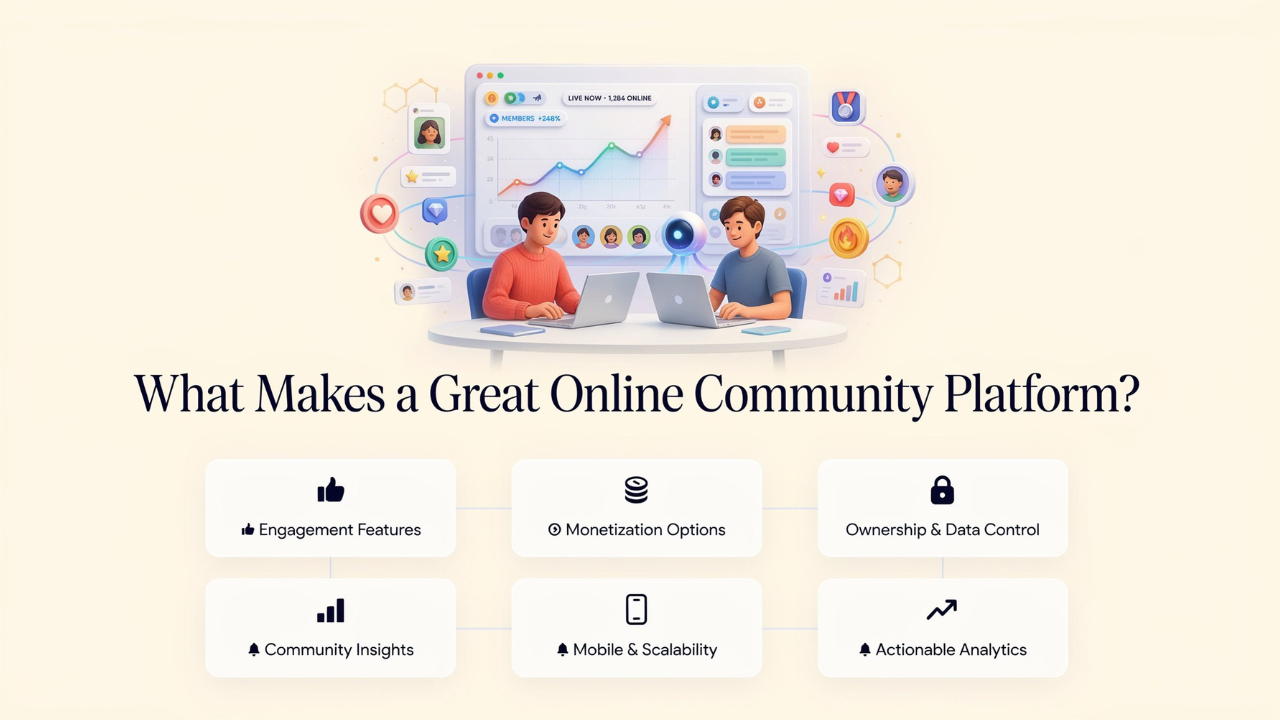
Before diving into specific tools, here's the framework for evaluating any community
Platform:
1. Engagement Features
A strong platform should feel alive. It should give people easy ways to talk, share, and join in. Things like discussions, chats, live sessions, or even small interactive features make a big difference.
But if they reply, ask questions, and come back again, you’re on the right track.
2. Monetisation Options
A good platform doesn’t make monetization complicated. It should allow you to earn directly without depending on other tools.
You should be able to offer memberships, sell courses, or run paid events smoothly. When everything works in one place,
3. Ownership & Data Control
Can you export your member list? Do you own the data? Can you migrate away if needed? These questions matter enormously when you're building a long-term business.
3. Ownership & Data Control
Can you export your member list? Do you own the data? Can you migrate away if needed?
These questions matter enormously when you're building a long-term business.
4. Analytics and Community Insights
Effective community platforms provide analytics that help administrators understand engagement levels, member activity, content performance, and retention trends.
5. Ease of Use, Mobile App & Scalability
People will mostly join from their phones, so the experience needs to be smooth and simple.
At the same time, the platform should grow with you. Whether you have a small group or a large audience, it should handle both without problems.
6. Actionable Analytics
Data is only useful when it tells you what to do next. A strong platform shows you how active your members are, what content works best, and where people lose interest. This helps you improve your community instead of guessing.
8 Best Online Community Platforms to Grow Faster
1. Cohortia (The AI-Powered Rising Star)
Cohortia is an AI online community platform built for creators, marketers, and coaches who want an active community without constant manual effort.
This integrates an AI layer that maintains conversations and engagement automatically with the essential community features, posts, chats, events, and courses.

At its core, Cohortia solves one key problem:
👉 communities fail due to inactivity, not lack of interest.
Key Benefits:
📢 AI-generated posts to keep conversations going
📢 Automated moderation to manage spam and enforce rules
📢 Built-in monetization (memberships, courses, events)
📢 SEO-friendly pages for organic growth
📢 Member profiles & feeds to encourage interaction
Best For
Creators and businesses who want consistent engagement without daily involvement
2. Circle — An All-Around Community Platform
Circle is a modern, all-in-one community platform built for creators and online businesses.
It combines discussions, courses, events, email, and automation into one clean, structured interface using “Spaces” to organize content and members.

Key Benefits
📢 Structured Spaces: Organize discussions and content with controlled access
📢 Automation: Onboard and engage members automatically
📢 Live Events: Host webinars and sessions inside the platform
📢 Built-in Email: Send updates without extra tools
📢 Analytics: Track engagement and member activity
Best For
Creators and businesses who want a scalable, professional community
3. Mighty Networks — Ideal for High-Engagement Communities
For Mighty Networks is a community platform built for engagement, courses, and mobile-first experiences.
It combines a social-style feed with structured communities, making it ideal for creators who want active, connected members.

Key Benefits
📢 AI member matching for better connections
📢 Groups & sub-communities for structure
📢 Built-in courses with video and quizzes
📢 Global payments for monetization
Best For
Creators who want high engagement and a mobile-first community.
4. Slack — Perfect for Real-Time Team and Professional Communities.
Originally designed as a tool for internal team communication, Slack has developed into a viable choice for developer groups, professional communities, and specialized networks.
With its familiar channel-based interface, Slack lowers the friction for members who already use it at work.

Key Benefits
📢 Channels & Threads: Keep discussions organized by topic
📢 Audio/Video Calls: Quick huddles for real-time interaction
📢 App Ecosystem: Add bots and automation easily
📢 Searchable History: Find past conversations quickly
Best For
Professional communities, developer groups, and B2B networks that rely on real-time interaction
5. Skool — Best for Simplicity and Gamified Engagement
Skool was founded by Sam Ovens, whose influence on the platform's marketing is unmistakable.
Built around a deliberately simple philosophy, one feed, clear topics, and easy navigation, Skool strips away everything non-essential to focus on what actually drives community engagement: discussion, courses, and gamification.

Key Benefits
📢 Leaderboards & rewards to drive activity
📢 Built-in discovery for organic growth
📢 Courses + community in one place
📢 Easy payments for memberships
📢 Events & reminders for engagement
Best For
Coaches and creators who want a simple, high-engagement community without complexity.
6. Bettermode — Best for B2B & SaaS Communities
In the B2B and SaaS markets, Bettermode has established itself as a community platform for businesses looking to create customer communities that lower support tickets, produce product feedback, and boost retention rather than for lone creators.

Key Benefits
📢 Adaptable builder: Establish knowledge bases, forums, and Q&A
📢 White-labeling: Fully customize branding and domain
📢 App integrations: Connect tools like Slack and Intercom
📢 Gamification: Use badges and leaderboards.
Best For
SaaS and digital businesses are building customer communities for support and retention.
7. Whop — Modular Community Platform for Creators
It is a newer, modular community platform that has grown rapidly among the creator and entrepreneur crowd.
Whop lets you build your community by selecting only the "apps" you need: a forum, chat rooms, courses, a link hub, a leaderboard, livestreaming, file downloads, and assembling them into your own custom space.

Key Benefits
📢 Modular setup like chat, forums, or courses
📢 Support real-time discussions
📢 Built-in livestreaming for live sessions
📢 Sell digital products alongside memberships
Best For
Creators and entrepreneurs who want a flexible, affordable community + monetization setup.
8. Discord — Platform for Niche Communities
Discord has evolved into one of the most widely used community platforms on the internet, hosting millions of communities across gaming, tech, crypto, art, music, education, and more.
Its channel-based structure, voice and video capabilities, and bot ecosystem make it uniquely powerful for highly engaged niche communities.

Key Benefits
📢 Channels to organize discussions
📢 Voice & video rooms for live interaction
📢 Bots for automation and moderation
📢 Threads for focused conversations
Best For
Niche communities that rely on real-time interaction and high engagement
3 Trends Growing Audiences Faster
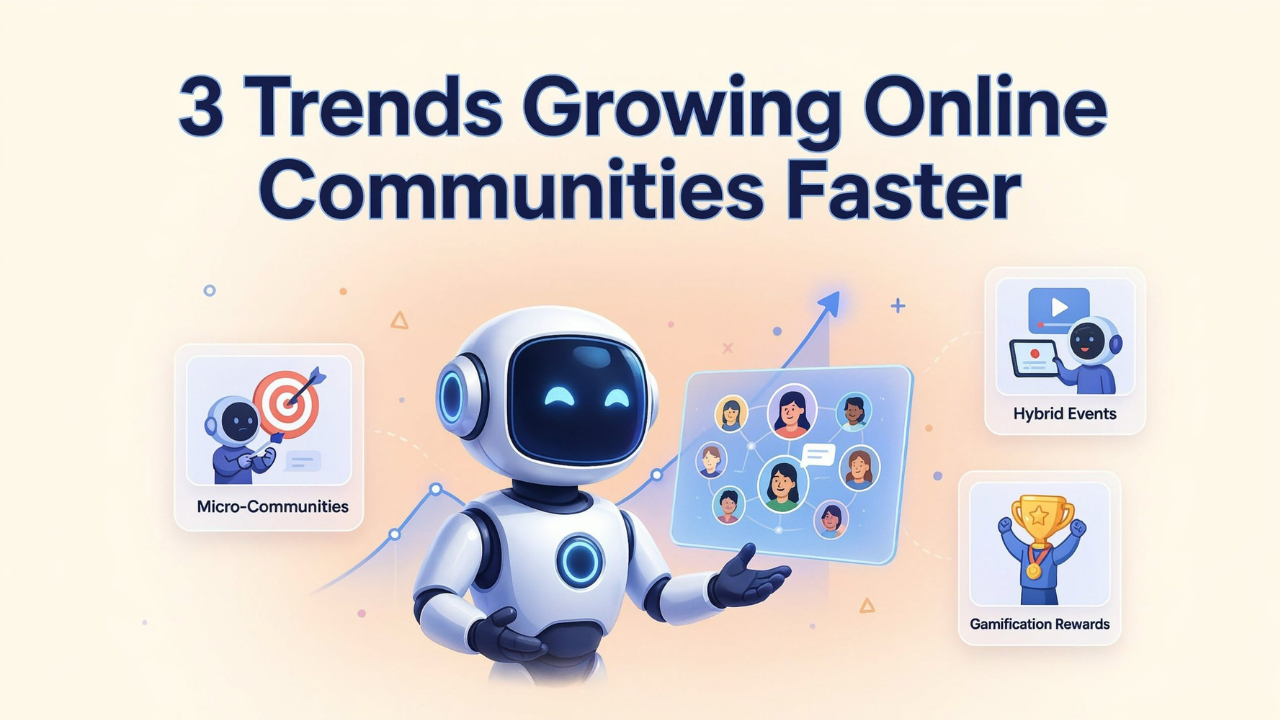
1. Micro-Communities > Mass Audiences
Which would you prefer - 50,000 followers or 100 engaged users? Smaller, niche communities are now driving higher levels of engagement, loyalty, and revenue.
Therefore, today people don’t want crowded groups anymore. They want focused spaces where they feel connected.
2. Hybrid Events (Live + Replay in One Place)
Imagine participating in a live session, conversing, and viewing the replay all from within the platform.
That’s where communities are heading. Modern platforms (including tools like Cohortia) are bringing events, discussions, and content into one place, making everything seamless.
- More participation
- Better content reuse
- Stronger retention
3. Gamification with Real Rewards
Engagement is no longer fueled by simple badges. Gamification thus has a connection to actual value.
- Unlock premium content
- Earn rewards or discounts
- Climb leaderboards with real benefits
So you sum up by saying reward meaningful participation, not just activity.
Conclusion
Every hour you spend on social media, you’re building on someone else’s platform. They control the reach, set the rules, and can change everything overnight. Now think about it, do you really want your audience to stay there forever?
Community platforms give you something different: a space you actually own.
As audience acquisition becomes more competitive, many creators and businesses are investing more heavily in owned community channels.
The creators growing the fastest today aren’t just chasing followers, they’re building ecosystems they control. If starting feels overwhelming or you’re worried about launching to silence, tools like Cohortia can help you get past that early phase by keeping your community active from the start.
However, if you don't take the initial step, none of this matters.
- Pick one platform from this list
- Try it for the next 14 days
- Start building your own space
FAQs about Best Online Community Platforms
1. Which is the best online community platform?
Ans: It depends on your goal. If you want automated engagement, Cohortia is a strong choice. If you need an all-in-one, scalable solution, Circle is a great option.
2. Do I need coding skills to build a community?
Ans: No. Most modern community platforms are no-code and easy to set up, even for beginners.
3. What’s the fastest way to grow a community?
Ans: Focus on a specific niche, encourage interaction, and stay consistent. Engagement matters more than audience size.